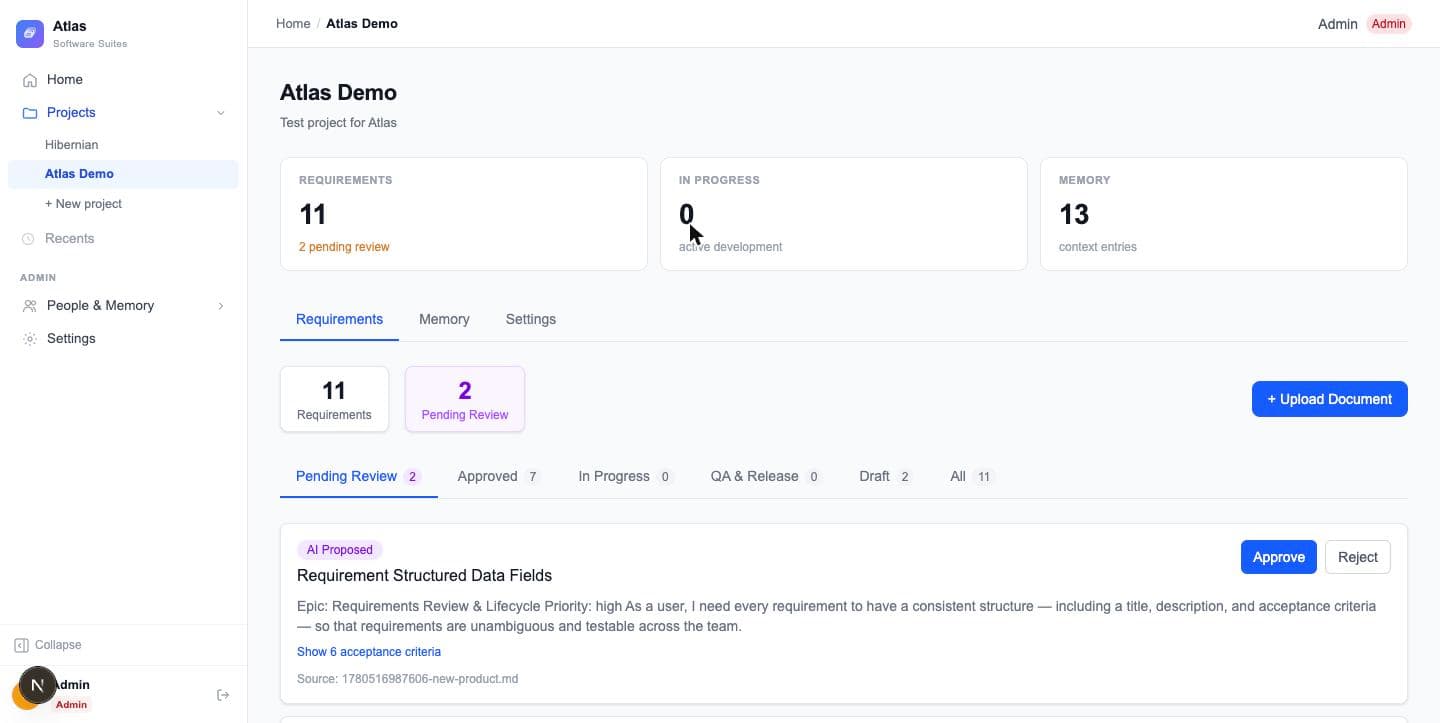
AI proposes a requirement — a TL approves or rejects it. Nothing ships without a human in the loop.
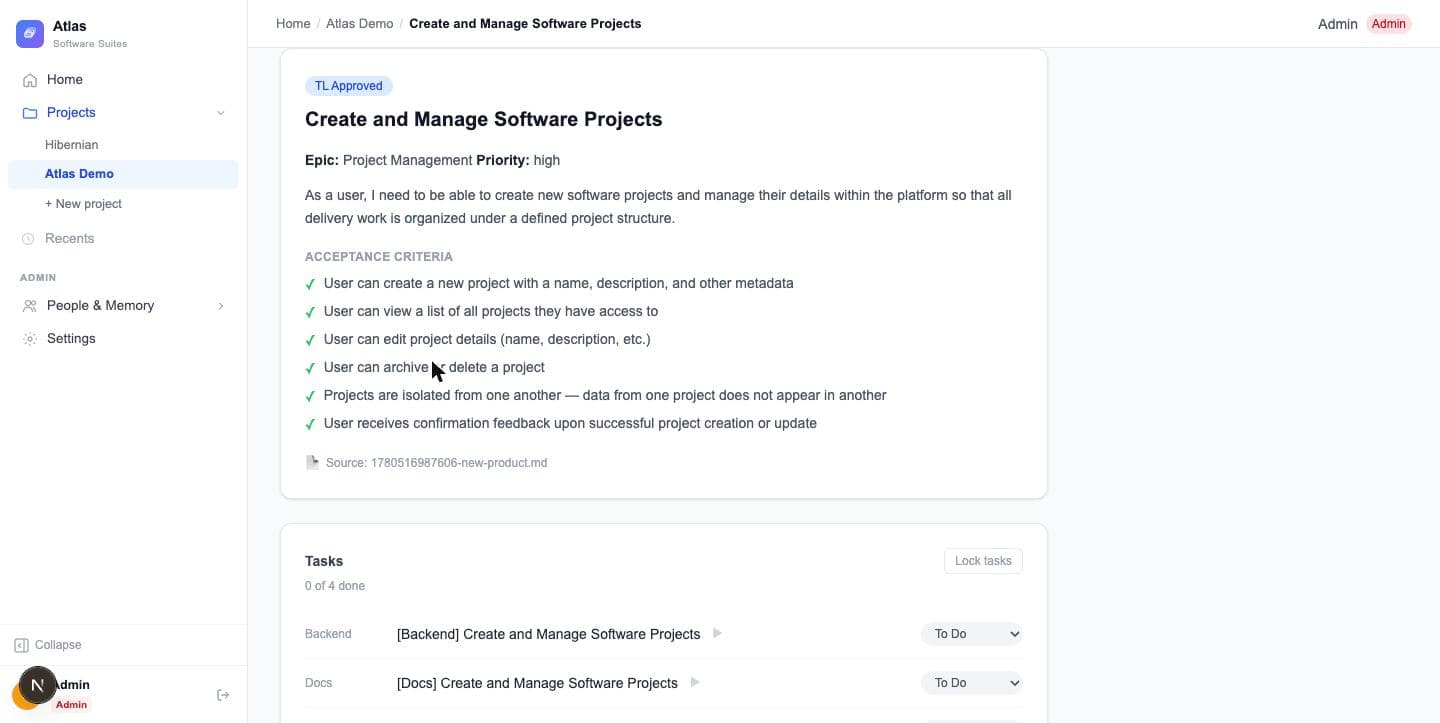
Approval auto-generates Backend, Frontend, QA, and Docs tasks — testable acceptance criteria included.
The problem
Your team is drowning in manual work
Traditional project tools manage tickets. Atlas manages knowledge, requirements, and delivery outcomes.
Tickets written by hand
PMs spend hours translating documents into tickets, introducing gaps and inconsistencies every time.
Context lives nowhere
Architecture decisions, stack conventions, and client constraints scatter across emails, Notion, and forgotten meetings.
Boards that lie
Your project board rarely reflects reality. Updates depend on human discipline — which is always in short supply.
Client feedback is lost
Requirements arrive as PDFs and email threads that never make it into your tracking tool.
Bugs vanish into Slack
A pasted stack trace or a "this is broken" message has no severity, no repro steps, and no owner — until someone remembers to write a ticket.
How it works
From document to deployed — in three steps
Upload your document
Drop in a PDF, Word doc, or paste raw text from any source — SOW, meeting notes, client email.
AI extracts requirements
Atlas agents analyze your document and propose structured requirements with acceptance criteria, tailored to your stack.
Approve, then ship
Approve a requirement and four tasks are auto-generated. The team ships; Atlas tracks every stage from dev to client sign-off.
What you get
Every layer of delivery, handled
AI agents work across the full stack of your delivery process, not just the ticket board.
Capture
Requirements Analyst Agent
Tool-use AI that reads your documents and extracts structured requirements — not vague summaries. Each one has a title, description, and testable acceptance criteria.
Bug Triage Agent
Paste a stack trace or an error log and Atlas extracts severity, repro steps, and affected area — then proposes fix tasks the same way it handles new requirements.
Developer Context Agent
Generates a ready-to-paste prompt for Claude Code, Cursor, or Copilot — built from the approved requirement and your project memory. Developers start coding with full context, not a one-line ticket title.
Deliver
16-stage delivery lifecycle
From AI proposal to client acceptance. Every status change is explicit — nothing falls through the cracks between QA and release.
Auto-generated tasks
Approve a requirement and Backend, Frontend, QA, and Docs tasks appear instantly. The team can start without a kickoff meeting.
Skill-matched assignee suggestions
The Task Generator Agent suggests the best-fit developer for each task based on their skills — the TL always confirms before anything is assigned.
GitHub integration
Commits and pull requests automatically advance requirements through the lifecycle. No manual status updates.
Know
Project Memory
Feed Atlas your stack, conventions, and architecture decisions. Every requirement is generated with your context, not generic boilerplate.
Memory Library
Running multiple client projects? Codify your stack and conventions once as a reusable template, then import them into every new project instead of re-explaining your standards from scratch each time.
Repository Intelligence & context audit
On-demand AI analysis of commits, PRs, and CI runs — plus a record of exactly what project context a developer had at the moment they pushed. TLs get a synthesized report on what's shipping, what's at risk, and whether the work was done with the right context.
Delivery analytics
See what's actually happening across your projects: throughput, bug ratio, workload per developer, and what's stuck — no spreadsheet required.
Be the first team to run on Atlas
We're onboarding early customers now. Join the waitlist and we'll reach out when your spot is ready.